

In today’s fast-paced digital world, texting has become more than just communication—it’s a language of its own. From emojis to abbreviations, keeping up with the latest texting lingo can feel like decoding a secret code. One abbreviation you’ve likely seen is DW. But what does it really mean in text? 🤔
Whether you’re texting friends, colleagues, or someone special, understanding abbreviations like DW can save you from confusion and miscommunication. In this guide, we’ll explore everything about DW meaning in text, its origins, examples, and tips for using it confidently.
What Does DW Mean in Text? 💬
The abbreviation DW primarily stands for “Don’t Worry”. It’s commonly used in casual messaging, social media, and online chats to reassure someone or to calm a situation.
- Example 1: Friend: “I might be late to the party.” You: “DW! We’ll wait for you 😄”
- Example 2: Friend: “I messed up the project.” You: “DW, everyone makes mistakes 👍”
It’s short, friendly, and often paired with emojis to add tone and emotion. 🥰
Origin of DW in Texting 📜
DW originated from early internet forums and chat rooms in the late 1990s and early 2000s. As messaging platforms evolved, abbreviations like DW became part of online shorthand to save time and effort.
The trend grew with instant messaging apps like WhatsApp, Messenger, and Discord, where quick responses are essential. Today, DW is widely recognized and used across generations. 🌐
When to Use DW in Texts ✅
DW is versatile, but context matters. Here’s when you can use it:
- To reassure someone: DW, it’s all good!
- To calm a friend in stressful situations: DW, we got this 😎
- In casual chats with friends, colleagues, or online communities
- Paired with emojis to enhance emotional tone: DW ❤️
DW vs. Other Common Abbreviations 🤯
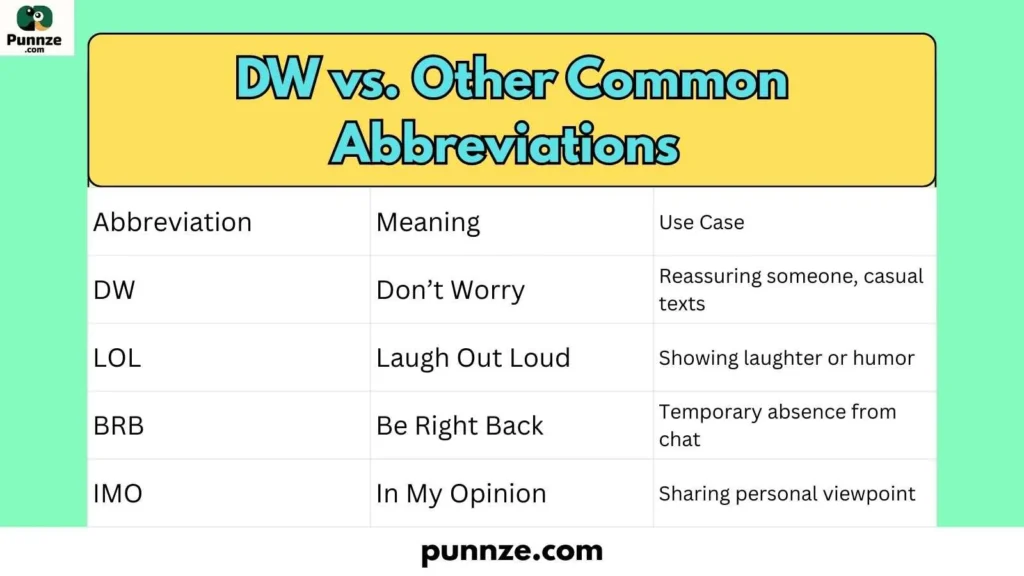
Texting has countless abbreviations. Understanding the difference helps avoid miscommunication:
| Abbreviation | Meaning | Use Case |
|---|---|---|
| DW | Don’t Worry | Reassuring someone, casual texts |
| LOL | Laugh Out Loud | Showing laughter or humor |
| BRB | Be Right Back | Temporary absence from chat |
| IMO | In My Opinion | Sharing personal viewpoint |
Examples of DW in Conversations 💌
Let’s look at real-life texting scenarios:
- Friend: “I didn’t bring the tickets.”
You: “DW, I got them 🎟️” - Colleague: “I’ll finish the report later.”
You: “DW, we have time ⏰” - Sibling: “I accidentally deleted the photos 😢”
You: “DW! I backed them up 💾”
DW in Professional Messaging 💼
While DW is mainly casual, it can sometimes appear in professional messaging if the environment is friendly or informal. Use it carefully:
- When texting close colleagues or team members
- In company chat tools like Slack or Teams (friendly tone only)
- Paired with reassurance: DW, we’ll fix this issue ✅
DW in Social Media Posts 📱
Social media users frequently use DW to add a casual and friendly vibe. Here’s how:
- Instagram captions: “Forgot the keys again 😅 DW, I have a spare!”
- Twitter replies: “DW, we got this!”
- Facebook comments: “DW, it’s just a minor mistake ❤️”
Alternative Meanings of DW 🌐
While “Don’t Worry” is the most common, DW can have other meanings depending on context:
- Dear Wife – often in personal messages
- Doctor Who – used by fans in sci-fi discussions
- Data Warehouse – in business/tech chats
Always consider the context to avoid misinterpretation! 🔍
How to Respond When Someone Sends DW 🤝
When a friend or contact sends DW, the response depends on your tone:
- Simple acknowledgment: Thanks! 😊
- Casual reply: Haha, DW then 😎
- Adding humor: DW, but don’t let it happen again 😂
DW and Emojis: Enhancing the Message 😍
Texting is emotional, and emojis help convey tone. Pair DW with emojis to express warmth, care, or humor:
- DW ❤️ – love and reassurance
- DW 😅 – playful tone
- DW 😎 – confident reassurance
- DW 😢 – empathy with support
Common Mistakes with DW ❌
Even simple abbreviations can be misused. Avoid these mistakes:
- Using DW in formal emails or messages
- Overusing DW, which can seem insincere
- Ignoring context, causing confusion
- Combining DW with negative words, e.g., “DW, you failed” (tone mismatch)
DW in Different Age Groups 👶🧑🧓

Understanding generational differences in texting is key:
- Teens & Young Adults: Use DW frequently in chats & social media
- Adults: Use DW selectively, often with colleagues or friends
- Older Adults: Less common; might not recognize DW immediately
Tips to Use DW Like a Pro 🏆
Here are expert tips to use DW effectively in text:
- Use it in friendly, informal contexts only
- Pair with emojis to convey emotion
- Observe the other person’s texting style
- Keep it short, simple, and reassuring
- Combine with other positive words: “DW, everything is fine 😊”
Fun Facts About DW 😄
- DW is recognized globally across multiple languages as “Don’t Worry”
- It has inspired memes and GIFs in online culture
- DW is often paired with other abbreviations like LOL or BRB
- DW can convey tone more effectively than typing a full sentence
- DW has been featured in texting guides and digital etiquette tips
DW in Pop Culture & Memes 🎬
Memes often use DW to make jokes or lighten moods. Examples include:
- Friend accidentally spills coffee: “DW, happens to the best of us ☕😂”
- Gaming group panic: “DW, we’ll win this round 🎮”
- Relationship humor: “DW, I remembered your birthday 🎂❤️”
Summary Table of DW Usage 📝
| Use | Meaning | Example |
|---|---|---|
| Reassurance | Don’t Worry | DW, it’s okay 😊 |
| Empathy | Support someone | DW, I understand 😢 |
| Casual chat | Friendly tone | DW! See you soon 😎 |
| Social media | Relaxed vibe | DW, we got this 💪 |
FAQs
1. Can DW be used in professional messages?
Yes, but only in informal, friendly professional chats. Avoid using DW in official emails. 💼
2. Does DW always mean Don’t Worry?
Mostly yes, but context matters. It can also mean Dear Wife, Doctor Who, or Data Warehouse depending on the conversation. 🌐
3. Can I use DW with emojis?
Absolutely! Emojis enhance tone and make your message warmer and more relatable. 😍
4. Is DW understood by all age groups?
DW is widely recognized among teens and young adults. Older adults may need context to understand it fully. 👵👴
5. How do I respond to DW in text?
You can acknowledge it with thanks, humor, or reassurance, depending on your relationship with the sender. 👍
Conclusion:
Understanding DW meaning in text is essential for modern digital communication. It’s a simple, friendly way to reassure, support, or lighten a conversation.
Remember, context is key, and pairing DW with emojis enhances your tone. Use it wisely, and you’ll communicate effectively, save time, and stay in tune with the texting culture. 📝

I’m passionate about explaining meanings in a straightforward and friendly way. On Punnze, I help readers understand words and ideas without confusion.